



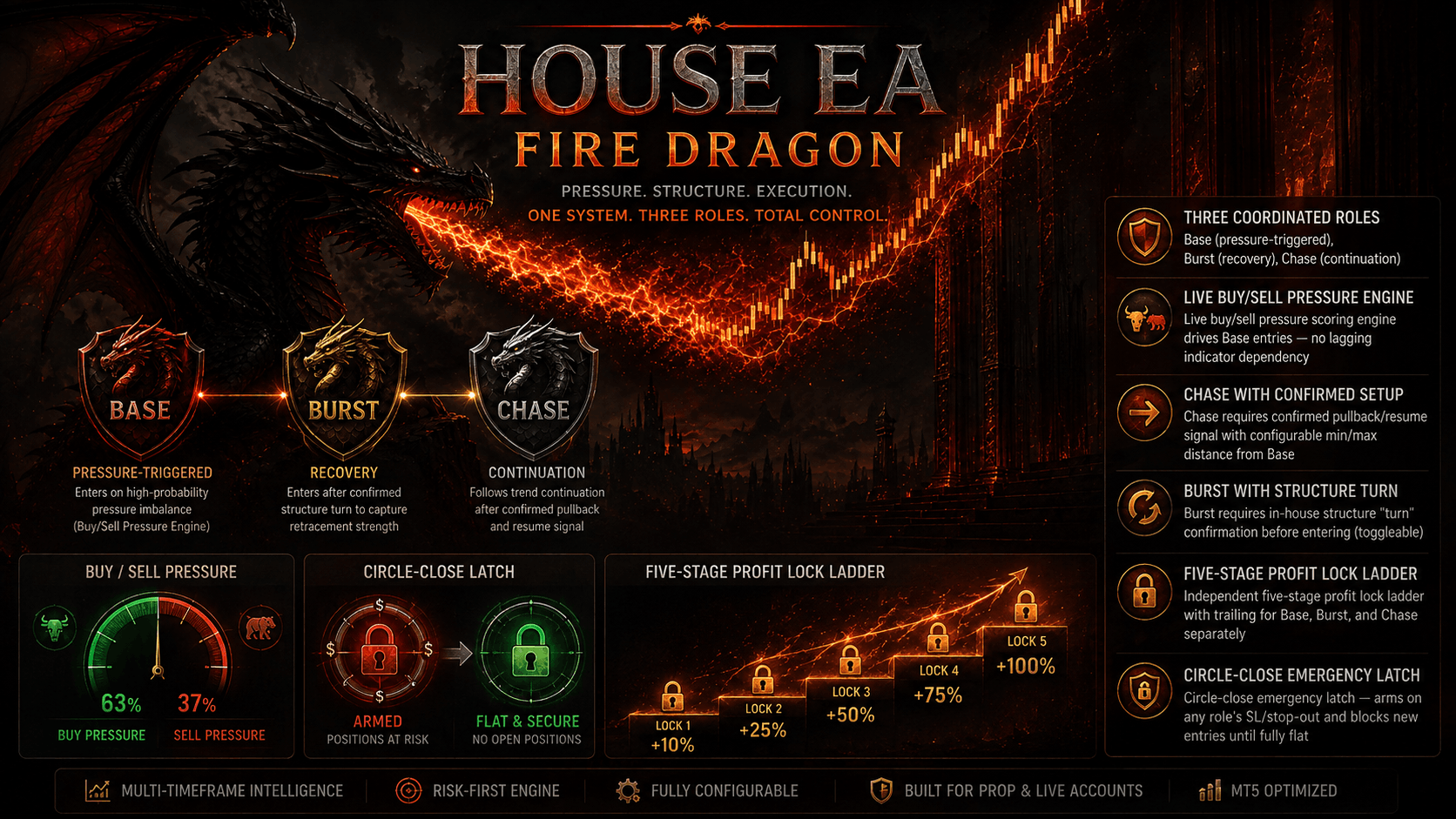


Day trading involves opening and closing positions within the same trading day to capitalize on short-term price fluctuations while avoiding overnight swap fees and gap risk. However, navigating intraday market dynamics requires extreme discipline, low-latency execution, and continuous adherence to a backtested quantitative strategy. Without systematic rules, manual execution quickly succumbs to cognitive fatigue, emotional slippage, and delayed entries.
London Breakout EA
High VolatilityAutomated algorithms designed to measure pre-market Asian consolidation ranges (00:00–07:00 GMT) and execute high-probability momentum trades when liquidity surges at the London session open (08:00 GMT).
Mean Reversion EA
Low RiskQuantitative range-bound systems engineered to identify statistically overbought or oversold market extremes during low-volatility Asian hours, targeting mean price return before major European catalysts.
The Anatomy of High-Probability Forex Day Trading Strategies
Successful currency day trading relies on exploitation of recurring institutional liquidity cycles. Foreign exchange markets do not move randomly; they operate around key interbank session opens—Tokyo, London, and New York. Capturing consistent intraday pips requires aligning algorithmic logic with institutional order flow, Fair Value Gaps (FVG), and key session high/low breakouts.
1. London Breakout Strategy Mechanics
The London trading session accounts for roughly 38% of global daily forex volume. Before London opens, price action during the Asian session frequently contracts into a narrow consolidation range. Automated London Breakout Expert Advisors (EAs) plot the high and low bounds of this range between 00:00 GMT and 07:00 GMT.
When European financial centers open at 08:00 GMT, institutional volume surges into the market, pushing price outside the Asian channel. Algorithms enter positions on verified candle closes or order book sweeps outside the range boundary, targeting dynamic Take Profits (TP) set at 1.5x to 2x the width of the Asian range while placing Stop Losses (SL) inside the opposite side of the channel.
2. Asian Session Mean Reversion Mechanics
Unlike the volatile London and New York overlaps, the Asian trading session exhibits reduced directional momentum and predictable range-bound behavior. Quantitative Mean Reversion trading bots leverage statistical indicators—such as Multi-Timeframe Relative Strength Index (RSI), Keltner Channels, and Bollinger Bands—to detect standard deviation extensions ($+2\sigma / -2\sigma$).
When price reaches an extreme boundary during late US or early Asian hours, the system triggers counter-trend orders targeting the 20-period Moving Average (MA). Combined with fixed time-stop exits before London session news releases, this approach offers a steady equity curve with low maximum drawdown.
Automated Day Trading vs. Manual Execution
Manually executing high-frequency intraday setups on MetaTrader 4 or 5 presents severe practical challenges. Missing an entry by 30 seconds due to screen delay or psychological hesitation can turn a winning risk-to-reward setup into a loss.
| Execution Factor | Manual Day Trading | Automated EAs (FXSnipers Cloud) |
|---|---|---|
| Execution Latency | 500ms – 3000ms (Manual reaction + local connection) | 1ms – 10ms (Cross-connected Low-Latency VPS) |
| Execution Consistency | Subject to hesitation, FOMO, fatigue, and early exits | 100% rule-based execution on pre-set parameters |
| Session Coverage | Limited to 4–8 hours of active screen monitoring | 24/5 continuous monitoring across all global sessions |
| Risk Control | Variable lot sizes, manual stop shifts during panic | Server-side fixed % risk per trade & strict equity stop-loss |
Eliminate Fatigue & Slippage with FXSnipers Algorithmic Infrastructure
Manually executing these day trading strategies can lead to severe fatigue, missed entries, and emotional decision-making. By utilizing FXSnipers' automated systems hosted on ultra-low latency Forex VPS infrastructure, you ensure every trade signal is executed with millisecond precision the moment setup criteria are met.
Whether you are deploying proprietary MQL4/MQL5 Expert Advisors, streaming signals via automated trade copiers, or tracking portfolio risk on your mobile device, bridging cloud algorithms with your MT4/MT5 account eliminates hardware dependencies, connection drops, and human error.
Frequently Asked Questions About Forex Day Trading Strategies
What is the best forex pair for London Breakout day trading?
Major pairs with high liquidity during European market hours—specifically GBPUSD, EURUSD, and EURGBP—offer the most consistent breakout volatility and lowest spreads for London Session EAs.
Can I run day trading EAs on MetaTrader 4 mobile apps?
No, native mobile MT4/MT5 apps cannot execute .ex4 or .ex5 automated scripts. You must host the EA on a Forex VPS, which runs continuously in the cloud and sends real-time push alerts to your smartphone.
How do I prevent drawdown during unexpected news events?
Automated trading systems incorporate news-filter modules that pause EA execution 30 minutes before and after high-impact economic releases (such as NFP, CPI, and Interest Rate decisions) to protect capital from extreme spread widening.